
21 december, 2013

17 december, 2013

09 december, 2013

07 december, 2013


04 december, 2013

24 november, 2013

22 november, 2013

20 november, 2013

19 november, 2013

17 november, 2013

16 november, 2013
14 november, 2013

13 november, 2013

12 november, 2013
09 november, 2013

08 november, 2013

05 november, 2013

02 november, 2013

26 oktober, 2013
22 oktober, 2013


20 oktober, 2013

19 oktober, 2013

13 oktober, 2013

12 oktober, 2013

10 oktober, 2013

09 oktober, 2013

06 oktober, 2013

05 oktober, 2013

04 oktober, 2013

03 oktober, 2013

02 oktober, 2013

29 september, 2013

28 september, 2013


25 september, 2013

24 september, 2013

22 september, 2013

20 september, 2013

18 september, 2013

15 september, 2013

14 september, 2013

10 september, 2013


09 september, 2013

16 augusti, 2013
12 augusti, 2013

13 maj, 2013

24 februari, 2013
20 februari, 2013
One of my faves have past away.
Brilliant philosopher of law who put human dignity at the centre of his moral system
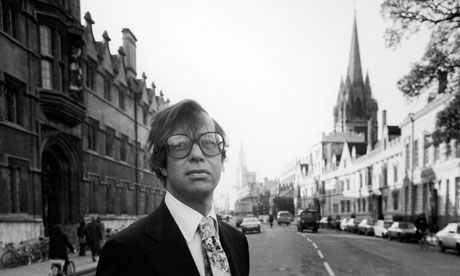
Ronald Dworkin at Oxford University in the 1970s. Photograph: Terrence Spencer/ Time & Life/Getty
Ronald Dworkin, who has died aged 81, was widely respected as the most original and powerful philosopher of law
in the English-speaking world. In his books, his articles and his
teaching, in London and New York, he developed a powerful, scholarly
exegesis of the law, and expounded issues of burning topicality and
public concern – including how the law should deal with race, abortion,
euthanasia and equality – in ways that were accessible to lay readers.
His legal arguments were subtly presented applications to specific
problems of a classic liberal philosophy
which, in turn, was grounded in his belief that law must take its
authority from what ordinary people would recognise as moral virtue.
Dworkin studied philosophy (under Willard Van Orman Quine at Harvard University and, informally, with JL Austin at Oxford University) and law at both Oxford and the Harvard Law School. He worked as clerk to the great US judge and legal scholar Billings Learned Hand and as a practising associate in the Wall Street law firm Sullivan & Cromwell, before teaching law at the Yale and later the New York University law schools, as well as at Oxford and later University College London.
This broad education and training, sharpening the analytical skills of a quite exceptionally powerful intellect, enabled him, even as a precocious young man, to challenge the most eminent figures in the world of law and jurisprudence, including Hand and HLA Hart, the renowned exponent of legal positivism – considering the social basis of a law separately from its merits – at Oxford. Perhaps Dworkin's greatest achievement was his insistence on a rights-based theory of law, expounded in his first and most influential book, Taking Rights Seriously (1977), in which he proposed an alternative both to Hart's outlook and to the newly minted theories of the Harvard philosopher of law John Rawls.
Dworkin spent much of his life in legal and philosophical controversy, in which he proved himself a capable and sometimes acerbic champion, defending his ideas with a sharpness that could surprise those who knew him personally as a gentle and affectionate man. He remained an unapologetic, indeed proud, liberal Democrat, unshaken in his loyalty to the New Deal tradition set by his hero Franklin D Roosevelt, even as such ideas became less and less widely held. It is possible that this shifting of the political centre of gravity under him deprived him of a more prominent career as a public intellectual. Within his own field, where law and philosophy meet, his reputation was unsurpassed, and almost unrivalled.
He was challenged technically within that field by the exponents of other doctrines, for example by the partisans of Hart, of Rawls and of Richard Rorty. He was more bitterly derided on political and ideological grounds by conservative legal scholars such as Robert Bork, with whom – improbably – he taught a joint course at the Yale Law School in the 60s. Throughout all these intellectual jousts, Dworkin was ever ready to break a lance, and gave at least as good as he got.
He chose to divide his life almost equally between Britain and the US, with a townhouse in London and an unusual 19th-century mews cottage just off Washington Square in New York, as well as a third home, on the island of Martha's Vineyard, Massachusetts, where he enjoyed sailing.
For a man who contrived, through sheer intellectual brilliance and a formidable capacity for work, to be both a consummate scholar's scholar and a lawyer's lawyer, Dworkin could give the impression of something not far from indolence. He loved company, talk, good food and drink, music, including opera, and travel, and moved easily through the different societies of New York and Martha's Vineyard, Oxford and London. Friends and family were more important to him than society, however, and work perhaps ultimately, in spite of his apparently self-indulgent lifestyle, more important than either.
Dworkin was born in Worcester, Massachusetts. His parents, David and Madeline (nee Talamo) separated when he was a baby, and his mother, a promising concert pianist, worked as a music teacher in Providence, Rhode Island, to support Ronald and his brother and sister. He went to a public school in Providence with a classical tradition, and won a scholarship to Harvard, where he achieved straight As in all his four years' classes.
Dworkin arrived as a Rhodes scholar at Magdalen College, Oxford, with a formidable reputation. Dons all but bowed before his record. He chose to read law, but he hung out with philosophers. (He also played a lot of bridge, much of it with his lifelong friend Guido Calabresi, later dean of the Yale Law School and an appeal court judge in Connecticut, New York and Vermont.) His Oxford finals papers were as impeccable as the Harvard ones: straight alphas, after straight As. His two years at Oxford finished, he went back to Harvard, this time to read law. The law school gave him credit for his Oxford degree, so there were areas of the law (including criminal law) he never studied.
The conventional start to a brilliant legal career in the US is to work as a clerk to a leading judge. In 1957 Dworkin, on the basis of his exceptional record at Harvard, was chosen to clerk for Judge Learned Hand, then in his late 80s and the most eminent judge in the land outside the supreme court. Often Hand's clerks went on to work for Justice Felix Frankfurter, and were made for life.
Hand explained that he did not need Dworkin to draft opinions for him: "I don't know how you write," the great man said. "I write very well." He asked him instead to read what he had written. This led immediately to a difference of opinion. Hand was writing a series of Oliver Wendell Holmes lectures for Harvard in which he questioned whether the Brown case (Brown v School Board, in which the supreme court, in 1954, held for the first time that racially segregated education was necessarily unconstitutional) had been wrongly decided. Dworkin bravely challenged Hand to say publicly that Brown was wrong.
While he was working for Hand, Dworkin met his future wife Betsy Ross, the daughter of a successful businessman from the New York garment district who lived on Fifth Avenue. On one of their first dates, Dworkin told her that he had to drop off a document at the judge's house and asked her to come with him, saying it would take only a second. Learned Hand opened the door and pressed the young people to come in. He mixed dry martinis and talked to them for two hours. As they left walking down the steps from the front door, Betsy asked: "If I see more of you, do I get to see more of him?" They were married in 1958.
Dworkin was duly offered the chance of clerking for Frankfurter, who was famous not only for his astute legal scholarship but also for the skill with which he promoted his proteges' careers. Instead, he took up an offer to work for Sullivan & Cromwell. One of his clients was the Swedish Wallenberg family and he had to spend a lot of time in Stockholm.
It was not long before Betsy objected to the amount of time her new husband spent travelling. She sent him a telegram saying that in a year he would have to get a new job or a new wife. Dworkin left the law firm and got a job teaching at Oxford. For a time the couple lived in the Oxfordshire countryside, but that was not the natural habitat for an elegant New Yorker like Betsy. Instead, they bought a house in Belgravia and Dworkin travelled to Oxford from the nearby Victoria coach station, leaving the bus outside University College, where he had his teaching rooms.
In 1961, Betsy had twins, Anthony, who now works on human rights and democracy at the European Council on Foreign Relations thinktank, and Jennifer, an award-winning documentary film producer. In the same year, Dworkin was made a professor at the Yale Law School, and also master of one of the Yale residential colleges, Trumbull. It fell to him in the late 60s to have to deal with the student unrest. Dworkin left Yale and became a professor at the New York University Law School. Arthur Schlesinger persuaded him that he would be happier in New York than at either Harvard or Yale. "New York is for grownups," the historian said gnomically.
Hart, who had been one of Dworkin's examiners at Oxford, was by then approaching retirement, and in 1969 he was able to persuade the Oxford law faculty to appoint Dworkin as his successor as professor of jurisprudence. As with Hand, Dworkin had learned from an older man, then crossed swords with him intellectually, but remained on good terms with him. He stayed in the post until 1998. Eventually, he accepted a chair in jurisprudence at University College London, perhaps on the principle that London, too, was for grownups.
His books were immensely influential, especially in US law schools. He published many articles both in technical law journals and also in the New York Review of Books, none more important than his critique in several articles in 1977 and 1978 of the supreme court's inconclusive decision of the Regents of the University of California v Bakke case, which arose out of widespread dissatisfaction with "affirmative action", or positive discrimination. Dworkin had by then already completed Taking Rights Seriously, in which he attacked legal positivism of the kind espoused by Hart, and elevated rights above formal law, at least in some hard cases. "If the issue is one touching fundamental personal or political rights," he wrote, "and it is arguable that the supreme court has made a mistake, a man is within his social rights in refusing to accept that decision as conclusive."
If one can dare to summarise so rich and lucid a lifetime's argument, Dworkin rejected both the traditional view, that judges must conform to established authority, and the belief of American liberals, that judges should seek to improve society, with a new emphasis on the judge's responsibility to uphold individual and collective morality.
After that came A Matter of Principle (1985), about the sources of law, and Law's Empire (1986), a full-dress theory of law. In Life's Dominion (1993) he tried characteristically to find common ground on abortion between pro-life and pro-choice forces in a common respect for human life. "Combatants and commentators alike talk as if the abortion controversy was about the rights and interests of a foetus ... liberals and conservatives, Catholics and feminists, actually argue about how and why human life has intrinsic value. This contradicts the pessimistic conclusion that accommodation is impossible." In Sovereign Virtue (2000), he wrestled with alternative views of equality, and in Justice in Robes (2006), he returned to a lifelong fascination with judges and the nature of adjudication.
Dworkin was always aware that law and in particular adjudication were, as he once put it, "a branch of morality". In 2011 he published Justice for Hedgehogs, an extended essay on this insight. The title was a reference to Isaiah Berlin's famous distinction between those intellectuals who, like the fox, have many ideas, and those who have "one big idea". Dworkin's big idea was to put human dignity at the centre of his moral system, for judges and for others. "If we manage to lead a good life," he wrote, "we make our lives tiny diamonds in the cosmic sands."
In 2000, Betsy died of cancer. Dworkin formed a close friendship with Irene Brendel, wife of the pianist Alfred Brendel, and they later married. He is survived by Irene, Anthony and Jennifer, and two grandchildren.
Ronald Myles Dworkin, philosopher of law, born 11 December 1931; died 14 February 2013
Dworkin studied philosophy (under Willard Van Orman Quine at Harvard University and, informally, with JL Austin at Oxford University) and law at both Oxford and the Harvard Law School. He worked as clerk to the great US judge and legal scholar Billings Learned Hand and as a practising associate in the Wall Street law firm Sullivan & Cromwell, before teaching law at the Yale and later the New York University law schools, as well as at Oxford and later University College London.
This broad education and training, sharpening the analytical skills of a quite exceptionally powerful intellect, enabled him, even as a precocious young man, to challenge the most eminent figures in the world of law and jurisprudence, including Hand and HLA Hart, the renowned exponent of legal positivism – considering the social basis of a law separately from its merits – at Oxford. Perhaps Dworkin's greatest achievement was his insistence on a rights-based theory of law, expounded in his first and most influential book, Taking Rights Seriously (1977), in which he proposed an alternative both to Hart's outlook and to the newly minted theories of the Harvard philosopher of law John Rawls.
Dworkin spent much of his life in legal and philosophical controversy, in which he proved himself a capable and sometimes acerbic champion, defending his ideas with a sharpness that could surprise those who knew him personally as a gentle and affectionate man. He remained an unapologetic, indeed proud, liberal Democrat, unshaken in his loyalty to the New Deal tradition set by his hero Franklin D Roosevelt, even as such ideas became less and less widely held. It is possible that this shifting of the political centre of gravity under him deprived him of a more prominent career as a public intellectual. Within his own field, where law and philosophy meet, his reputation was unsurpassed, and almost unrivalled.
He was challenged technically within that field by the exponents of other doctrines, for example by the partisans of Hart, of Rawls and of Richard Rorty. He was more bitterly derided on political and ideological grounds by conservative legal scholars such as Robert Bork, with whom – improbably – he taught a joint course at the Yale Law School in the 60s. Throughout all these intellectual jousts, Dworkin was ever ready to break a lance, and gave at least as good as he got.
He chose to divide his life almost equally between Britain and the US, with a townhouse in London and an unusual 19th-century mews cottage just off Washington Square in New York, as well as a third home, on the island of Martha's Vineyard, Massachusetts, where he enjoyed sailing.
For a man who contrived, through sheer intellectual brilliance and a formidable capacity for work, to be both a consummate scholar's scholar and a lawyer's lawyer, Dworkin could give the impression of something not far from indolence. He loved company, talk, good food and drink, music, including opera, and travel, and moved easily through the different societies of New York and Martha's Vineyard, Oxford and London. Friends and family were more important to him than society, however, and work perhaps ultimately, in spite of his apparently self-indulgent lifestyle, more important than either.
Dworkin was born in Worcester, Massachusetts. His parents, David and Madeline (nee Talamo) separated when he was a baby, and his mother, a promising concert pianist, worked as a music teacher in Providence, Rhode Island, to support Ronald and his brother and sister. He went to a public school in Providence with a classical tradition, and won a scholarship to Harvard, where he achieved straight As in all his four years' classes.
Dworkin arrived as a Rhodes scholar at Magdalen College, Oxford, with a formidable reputation. Dons all but bowed before his record. He chose to read law, but he hung out with philosophers. (He also played a lot of bridge, much of it with his lifelong friend Guido Calabresi, later dean of the Yale Law School and an appeal court judge in Connecticut, New York and Vermont.) His Oxford finals papers were as impeccable as the Harvard ones: straight alphas, after straight As. His two years at Oxford finished, he went back to Harvard, this time to read law. The law school gave him credit for his Oxford degree, so there were areas of the law (including criminal law) he never studied.
The conventional start to a brilliant legal career in the US is to work as a clerk to a leading judge. In 1957 Dworkin, on the basis of his exceptional record at Harvard, was chosen to clerk for Judge Learned Hand, then in his late 80s and the most eminent judge in the land outside the supreme court. Often Hand's clerks went on to work for Justice Felix Frankfurter, and were made for life.
Hand explained that he did not need Dworkin to draft opinions for him: "I don't know how you write," the great man said. "I write very well." He asked him instead to read what he had written. This led immediately to a difference of opinion. Hand was writing a series of Oliver Wendell Holmes lectures for Harvard in which he questioned whether the Brown case (Brown v School Board, in which the supreme court, in 1954, held for the first time that racially segregated education was necessarily unconstitutional) had been wrongly decided. Dworkin bravely challenged Hand to say publicly that Brown was wrong.
While he was working for Hand, Dworkin met his future wife Betsy Ross, the daughter of a successful businessman from the New York garment district who lived on Fifth Avenue. On one of their first dates, Dworkin told her that he had to drop off a document at the judge's house and asked her to come with him, saying it would take only a second. Learned Hand opened the door and pressed the young people to come in. He mixed dry martinis and talked to them for two hours. As they left walking down the steps from the front door, Betsy asked: "If I see more of you, do I get to see more of him?" They were married in 1958.
Dworkin was duly offered the chance of clerking for Frankfurter, who was famous not only for his astute legal scholarship but also for the skill with which he promoted his proteges' careers. Instead, he took up an offer to work for Sullivan & Cromwell. One of his clients was the Swedish Wallenberg family and he had to spend a lot of time in Stockholm.
It was not long before Betsy objected to the amount of time her new husband spent travelling. She sent him a telegram saying that in a year he would have to get a new job or a new wife. Dworkin left the law firm and got a job teaching at Oxford. For a time the couple lived in the Oxfordshire countryside, but that was not the natural habitat for an elegant New Yorker like Betsy. Instead, they bought a house in Belgravia and Dworkin travelled to Oxford from the nearby Victoria coach station, leaving the bus outside University College, where he had his teaching rooms.
In 1961, Betsy had twins, Anthony, who now works on human rights and democracy at the European Council on Foreign Relations thinktank, and Jennifer, an award-winning documentary film producer. In the same year, Dworkin was made a professor at the Yale Law School, and also master of one of the Yale residential colleges, Trumbull. It fell to him in the late 60s to have to deal with the student unrest. Dworkin left Yale and became a professor at the New York University Law School. Arthur Schlesinger persuaded him that he would be happier in New York than at either Harvard or Yale. "New York is for grownups," the historian said gnomically.
Hart, who had been one of Dworkin's examiners at Oxford, was by then approaching retirement, and in 1969 he was able to persuade the Oxford law faculty to appoint Dworkin as his successor as professor of jurisprudence. As with Hand, Dworkin had learned from an older man, then crossed swords with him intellectually, but remained on good terms with him. He stayed in the post until 1998. Eventually, he accepted a chair in jurisprudence at University College London, perhaps on the principle that London, too, was for grownups.
His books were immensely influential, especially in US law schools. He published many articles both in technical law journals and also in the New York Review of Books, none more important than his critique in several articles in 1977 and 1978 of the supreme court's inconclusive decision of the Regents of the University of California v Bakke case, which arose out of widespread dissatisfaction with "affirmative action", or positive discrimination. Dworkin had by then already completed Taking Rights Seriously, in which he attacked legal positivism of the kind espoused by Hart, and elevated rights above formal law, at least in some hard cases. "If the issue is one touching fundamental personal or political rights," he wrote, "and it is arguable that the supreme court has made a mistake, a man is within his social rights in refusing to accept that decision as conclusive."
If one can dare to summarise so rich and lucid a lifetime's argument, Dworkin rejected both the traditional view, that judges must conform to established authority, and the belief of American liberals, that judges should seek to improve society, with a new emphasis on the judge's responsibility to uphold individual and collective morality.
After that came A Matter of Principle (1985), about the sources of law, and Law's Empire (1986), a full-dress theory of law. In Life's Dominion (1993) he tried characteristically to find common ground on abortion between pro-life and pro-choice forces in a common respect for human life. "Combatants and commentators alike talk as if the abortion controversy was about the rights and interests of a foetus ... liberals and conservatives, Catholics and feminists, actually argue about how and why human life has intrinsic value. This contradicts the pessimistic conclusion that accommodation is impossible." In Sovereign Virtue (2000), he wrestled with alternative views of equality, and in Justice in Robes (2006), he returned to a lifelong fascination with judges and the nature of adjudication.
Dworkin was always aware that law and in particular adjudication were, as he once put it, "a branch of morality". In 2011 he published Justice for Hedgehogs, an extended essay on this insight. The title was a reference to Isaiah Berlin's famous distinction between those intellectuals who, like the fox, have many ideas, and those who have "one big idea". Dworkin's big idea was to put human dignity at the centre of his moral system, for judges and for others. "If we manage to lead a good life," he wrote, "we make our lives tiny diamonds in the cosmic sands."
In 2000, Betsy died of cancer. Dworkin formed a close friendship with Irene Brendel, wife of the pianist Alfred Brendel, and they later married. He is survived by Irene, Anthony and Jennifer, and two grandchildren.
Ronald Myles Dworkin, philosopher of law, born 11 December 1931; died 14 February 2013
08 februari, 2013
The Nordic countries...
SMALLISH countries are often in the vanguard when it comes to reforming government. In the 1980s Britain was out in the lead, thanks to Thatcherism and privatisation. Tiny Singapore has long been a role model for many reformers. Now the Nordic countries are likely to assume a similar role.
That is partly because the four main Nordics—Sweden, Denmark, Norway and Finland—are doing rather well. If you had to be reborn anywhere in the world as a person with average talents and income, you would want to be a Viking. The Nordics cluster at the top of league tables of everything from economic competitiveness to social health to happiness. They have avoided both southern Europe’s economic sclerosis and America’s extreme inequality. Development theorists have taken to calling successful modernisation “getting to Denmark”. Meanwhile a region that was once synonymous with do-it-yourself furniture and Abba has even become a cultural haven, home to “The Killing”, Noma and “Angry Birds”.
As our special report this week explains, some of this is down to lucky timing: the Nordics cleverly managed to have their debt crisis in the 1990s. But the second reason why the Nordic model is in vogue is more interesting. To politicians around the world—especially in the debt-ridden West—they offer a blueprint of how to reform the public sector, making the state far more efficient and responsive.
From Pippi Longstocking to private schools
The idea of lean Nordic government will come as a shock both to
French leftists who dream of socialist Scandinavia and to American
conservatives who fear that Barack Obama is bent on “Swedenisation”.
They are out of date. In the 1970s and 1980s the Nordics were indeed
tax-and-spend countries. Sweden’s public spending reached 67% of GDP in
1993. Astrid Lindgren, the inventor of Pippi Longstocking, was forced to
pay more than 100% of her income in taxes. But tax-and-spend did not
work: Sweden fell from being the fourth-richest country in the world in
1970 to the 14th in 1993.Since then the Nordics have changed course—mainly to the right. Government’s share of GDP in Sweden, which has dropped by around 18 percentage points, is lower than France’s and could soon be lower than Britain’s. Taxes have been cut: the corporate rate is 22%, far lower than America’s. The Nordics have focused on balancing the books. While Mr Obama and Congress dither over entitlement reform, Sweden has reformed its pension system (see Free exchange). Its budget deficit is 0.3% of GDP; America’s is 7%.
On public services the Nordics have been similarly pragmatic. So long as public services work, they do not mind who provides them. Denmark and Norway allow private firms to run public hospitals. Sweden has a universal system of school vouchers, with private for-profit schools competing with public schools. Denmark also has vouchers—but ones that you can top up. When it comes to choice, Milton Friedman would be more at home in Stockholm than in Washington, DC.
All Western politicians claim to promote transparency and technology. The Nordics can do so with more justification than most. The performance of all schools and hospitals is measured. Governments are forced to operate in the harsh light of day: Sweden gives everyone access to official records. Politicians are vilified if they get off their bicycles and into official limousines. The home of Skype and Spotify is also a leader in e-government: you can pay your taxes with an SMS message.
This may sound like enhanced Thatcherism, but the Nordics also offer something for the progressive left by proving that it is possible to combine competitive capitalism with a large state: they employ 30% of their workforce in the public sector, compared with an OECD average of 15%. They are stout free-traders who resist the temptation to intervene even to protect iconic companies: Sweden let Saab go bankrupt and Volvo is now owned by China’s Geely. But they also focus on the long term—most obviously through Norway’s $600 billion sovereign-wealth fund—and they look for ways to temper capitalism’s harsher effects. Denmark, for instance, has a system of “flexicurity” that makes it easier for employers to sack people but provides support and training for the unemployed, and Finland organises venture-capital networks.
The sour part of the smorgasbord
The new Nordic model is not perfect. Public spending as a proportion
of GDP in these countries is still higher than this newspaper would
like, or indeed than will be sustainable. Their levels of taxation still
encourage entrepreneurs to move abroad: London is full of clever young
Swedes. Too many people—especially immigrants—live off benefits. The
pressures that have forced their governments to cut spending, such as
growing global competition, will force more change. The Nordics are
bloated compared with Singapore, and they have not focused enough on
means-testing benefits.All the same, ever more countries should look to the Nordics. Western countries will hit the limits of big government, as Sweden did. When Angela Merkel worries that the European Union has 7% of the world’s population but half of its social spending, the Nordics are part of the answer. They also show that EU countries can be genuine economic successes. And as the Asians introduce welfare states they too will look to the Nordics: Norway is a particular focus of the Chinese.
The main lesson to learn from the Nordics is not ideological but practical. The state is popular not because it is big but because it works. A Swede pays tax more willingly than a Californian because he gets decent schools and free health care. The Nordics have pushed far-reaching reforms past unions and business lobbies. The proof is there. You can inject market mechanisms into the welfare state to sharpen its performance. You can put entitlement programmes on sound foundations to avoid beggaring future generations. But you need to be willing to root out corruption and vested interests. And you must be ready to abandon tired orthodoxies of the left and right and forage for good ideas across the political spectrum. The world will be studying the Nordic model for years to come.
05 februari, 2013
23 januari, 2013
UK, EU och SE.
I upptrappningen till det tal som Cameron hade idag kan man notera att media gärna diskuterar EU-medlemskapets vara eller inte vara. Sant är att mycket inom EU måste förändras. Den inre marknaden fungerar väl och samhörigheten mellan européer (trots den finansiella krisen) är större än någonsin. När media och medborgare talar om utträde fokuserar de oftast på hur mycket bättre allt är som enskilt land utanför EU. Tänk så mycket självbestämmande man skulle ha. Skulle UK lämna EU så försvinner 14% av den inre marknaden men totalt sett skulle UK ändå vara beroende av att följa mycket av reglerna som beslutas i Bryssel. Det är mycket inom EU som behöver reformeras. Jordbrukspolitiken och den framväxande protektionismen är två exempel. Värst är det för de frihandelsvänliga krafterna inom EU, som tillika är de stora finansiärerna av unionen, som förlorar en stark partners. Mats Persson, Open Europe, skrev i DN Debatt att attityden till EU inte handlar om ett JA eller NEJ. Istället utkristalliseras en tredje väg som framtvingats av politiskt och ekonomiskt starka krafter. Det handlar om vilket EU vi vill ha. Faktum kvarstår att EU som gemensam marknad och reglerare är något positivt.
Dimensionerna är i denna diskussion flera. Hur påverkas Sverige, EU och UK? D
Alla är vi beroende av EU. Regionalt arbete är viktigare än någonsin särskilt när det gäller handel. Globala värdekedjor lyser inte med sin frånvaro men regionaltarbete kommer alltid vara i fokus. UK, som hade 1/3 av världen under sina fötter för 70 år sedan kommer bli en allt mindre spelare i framtiden. EU som handelsblock, särskilt med utvidgning österut, kommer vara viktigare. Låt hoppas att UKs EU-agenda resulterar i en positiv förändring av unionen där diskussioner om jordbruksstöd etc. äntligen kan inledas och att ytterligare liberaliseringar blir resultatet. För Sveriges del behöver vi liberala partners i EU och UK är en sådan. UKs medborgare kommer antagligen bli besvikna när de vaknar upp efter att ha lämnat EU och friheten inte levererade vad de egentligen hoppades på.
_____________________
Britain and Europe
Making the break
How Britain could fall out of the European Union, and what it would mean
Dec 8th 2012 |From The Economist - print edition
BRITAIN has never been too keen on tying the knot with Europe. It sat aside in the 1950s as Germany, France, Italy and the Benelux countries forged a single market in coal and steel, which became a broader common market. It eventually joined, in 1973, largely because Europe seemed to be where the money was. Britons still think of their relationship with Europe as a transaction. But their feelings about the costs and benefits of membership have changed utterly.
Europe is no longer the thriving economic club that Britain joined 40 years ago. The euro-zone crisis has exposed the lack of dynamism in much of Europe (though Britain itself is hardly booming) and the British also feel sidelined, as countries that use the single currency are pulled more tightly together. Britons have come to associate the EU with the uncontrolled immigration of Poles and other east Europeans, seemingly to every village. Although many political leaders are determined to stop it happening, a British exit from Europe is coming to seem ever more possible.
If Britain falls out of the EU, it may find itself completely outside the single market. It might try to stay in the European Economic Area (EEA), a free-trade club that also includes Iceland and Norway. Or it could leave both the EU and the single market, but attempt to recreate a free-trade relationship through bilateral agreements. In this article we explain what each would mean for British business and the economy. But, first, how could an exit happen?
Almost by accident
The likeliest trigger is a referendum. David Cameron, Britain’s prime minister, is under enormous pressure to call one from his own Conservative Party, which dominates Britain’s coalition government. Last year 81 Tory MPs voted for a referendum on Britain’s EU membership. “It’s moved very fast,” says John Redwood, a veteran critic of the EU. “People used to call me an extreme Eurosceptic. Now I’m a moderate.”
Truly fervent Eurosceptics seek a referendum because they want to quit the EU. Other Tories want one to spike the guns of the UK Independence Party (UKIP), which campaigns for an exit. UKIP, a once-minor party that came second to Labour in two by-elections on November 29th, takes votes from all parties but most terrifies Conservative MPs. If the party does well in the next European Parliament elections, due in 2014, the pressure on Mr Cameron will increase.
He is already bending. In September the prime minister hinted that Britons might have an opportunity to give “fresh consent” to their country’s place in a looser union—a rather fuzzy suggestion that is unlikely to dampen calls for a starker question. Some Tory cabinet ministers now expect the party to include a promise of an “In-Out” referendum on Europe in its 2015 general-election manifesto.
That might persuade Labour to follow suit—which is the second referendum scenario. Although the party is broadly pro-European, some Labour strategists have been urging Ed Miliband, its leader, to promise a referendum all the same, chiefly to pile pressure on Mr Cameron but also to stay on the right side of public opinion. “Whatever our position on Europe, we cannot be seen as the anti-referendum party,” a senior Labour figure says.
The third scenario is already in play, thanks to the 2011 European Union Act. Passed by the coalition, this dictates that a referendum must be held on any new EU treaty that shifts power from Westminster to Brussels. The EU is acutely aware of this obstacle, so where treaty change is envisaged, it is trying to focus it as narrowly as possible on the euro zone, of which Britain is not a member. But the EU’s creeping claim on its constituents’ sovereign powers suggests that this “referendum lock” could be activated. The next treaty change, which could take place in 2015 or 2016, will be the moment for Mr Cameron (if he is re-elected) to try to repatriate some powers from Brussels in the “new settlement” he seeks with Europe. If Britons voted to reject the revised treaty there would be redoubled pressure for a second referendum, on their membership of the European club.
There is a fourth scenario: simple diplomatic miscalculation. A year ago, at a summit where they agreed on a fiscal compact, almost all other EU leaders banded together to sidestep a British veto. If that were to happen again on an issue that Britons care more deeply about, Mr Cameron may face irresistible pressure to call an early referendum.
The early signs are that Britons would opt to push off. YouGov’s latest poll on the issue suggests that 49% would vote to leave, whereas only 32% would choose to stay (the rest are unsure). One senior Tory, who wants Britain to stay in, says blankly that it would be impossible to win a referendum at the moment.
The leaders of all three main parties, backed by business and trade unions, could try to woo Britons to Europe. But they would have plenty of opposition, and not just from other MPs. When Britain last voted on Europe, in 1975, every national newspaper except theMorning Star campaigned for an “In” vote. That will not be repeated. Britain’s two biggest-selling dailies, the Daily Mail and the Sun—combined circulation, 4.5m—are deeply Eurosceptic.
What would make the vote unpredictable is that Britons cannot have what they really want. If offered a “detached relationship that is little more than a free-trade agreement”, according to the same YouGov poll, only 26% would still opt for the exit. The biggest group of respondents, 46%, would accept those looser terms. But continental leaders are unwilling to grant Britain full access to the single market without the costly bits. Germany’s chancellor, Angela Merkel, says she dearly wants to keep Britain in the EU—but “as a good partner”. In the run-up to a promised referendum, Mr Cameron could win only trifling concessions. That might convince some Britons that life outside the EU would be difficult; but it might equally inflame Eurosceptic opinion and make an “out” vote more likely.
Very well, alone
If Britain walked away entirely—the most extreme scenario—it would quickly see some benefits. The country would no longer have to transfer funds to the EU to subsidise farm incomes or poorer regions. Treasury figures suggest it would be £8 billion ($13 billion) better off each year. Food could become cheaper. Under WTO rules, countries may slash import barriers unilaterally as long as they do not favour some countries over others. Britain could do this for agricultural produce. It would regain control over fishing rights around its coast.
Some irksome regulations could be ditched, too. First to go (if the Tories are in power when Britain leaves) would be the working-time directive. This limits how long people can be at work without a break or a holiday and caps the working week at 48 hours. The scrapping of the EU’s agency-worker directive, which gives temporary staff the same rights as regular employees, would be cheered by business, too. Britain would be free to set itself a less exacting target for green-power generation than it is bound to under the EU’s renewable-energy directive. That could mean cheaper power.
London’s financial district would look to past glories. It thrived as an offshore centre for deposit-taking and loan-making in dollars long before Britain joined the EU. Outside the club, it would be freer to market itself as a freewheeling hub for emerging-market finance—a sort of Singapore on steroids. Free of the obligation to abide by ever-changing EU rules on alternative investments, hedge funds that have left London might be lured back. The burden of impending European Solvency 2 regulations on the insurance industry would become less onerous.
Yet a bonfire of regulations would smoulder rather than blaze. Domestic and global commitments to greenery constrain Britain’s energy policy, for example. And EU regulations bite less hard than is commonly supposed. Britain already has one of the most flexible labour markets in the rich world (employees can opt out of the 48-hour week). This helps to explain why the unemployment rate is as low as in America or Canada, despite a more sluggish economy.
Product regulations would be harder to junk than labour laws. The British suppliers to Airbus, the Franco-German aircraft manufacturer, have to comply with exacting standards. But these exist not because of meddling by Brussels, but to ensure aircraft are safe. Similarly, a minimum standard of food safety stops a race to the bottom by competing firms. British ones would still have to observe Europe’s product regulations in order to export there. A separate set of regulations tailored for the home market would only add to red tape.
That goes for the City, too. Global finance favours common standards, such as the Basel accords on bank capital. And, far from racing to the bottom, countries with large financial sectors are now as likely to create even tougher rules. The Bank of England has hinted that Basel is not strong enough.
And some immediate gains would evaporate as special-interest groups redirected their attention from Brussels to Westminster. British farmers would lose £2.7 billion in EU subsidies once Britain left. They are a noisy lobby group, and it is unlikely that the government would hang on to all that cash. The farming lobby would also try to stand in the way of lowering tariffs on food imported from beyond Europe, potentially depriving the government of a bargaining chip in trade negotiations with big emerging markets such as Brazil and India.
If the benefits of leaving the single market are qualified, what of the costs? The price of exclusion is much smaller than when Britain joined in 1973. Tariff barriers across the world have been steadily lowered in trade deals brokered by GATT and its successor, the WTO. If import tariffs are weighted by the volume of trade in each product, the average faced by exporters from outside the EU into the single market has fallen to around 3%. Exporters routinely have to absorb cost increases of this size caused by a surge in the oil price or a jump in the exchange rate.
Even so, the impact on industries such as food and textiles, where tariffs are much higher than the average, would be far from mild. British dairy exports would incur an import tax of 55% to reach the EU market, with tariffs on some items of more than 200%. Cheddar cheese would face a tariff of €167 per 100kg; the mark-up on Stilton would be €141. Average tariffs on clothing would push up their price in European markets by 12%.
Parts of Britain’s car industry would move out. British-based producers would face a 4% tariff on car-equipment sales to the EU, and there would be pressure to impose tariffs on components imported from it. Factories owned by carmakers with plants and supply chains in other parts of the EU would be most at risk. Vital car components might be held up by customs as they leave the continent. A cheap pound and a flexible workforce may not be enough to keep GM in Britain, for instance, even though it sells many cars there.
The calculation would be slightly different for other carmakers. Only a small fraction of the 300,000 cars Jaguar Land Rover makes in Britain are destined for the EU market. A lot of Minis, made in Britain by BMW, are also sold outside Europe, where they attract an import tariff anyway. Much of what distinguishes a Jaguar from a Mercedes is that it is designed and made in Britain (as are lots of components). There would be little benefit, but huge costs to the brand, in shifting production elsewhere. Japanese carmakers would suffer: most of their British output is sold in the EU, says John Leech of KPMG, a consultancy. But they cannot easily switch production to continental factories, and many of their supplies come from Japan. They would stick around longer than many think.
Over time, though, the general drift of business investment would be away from Britain and towards the continent. That goes for finance, too. If London wants to be the regional hub for trading China’s currency, it will need to retain its position as the main centre for settling trades of cash and derivatives in euros. Some in Europe resent this: the governor of France’s central bank complained this week that euro deals should be done in euroland. Without the shield of single-market rules, London could lose out to rival EU centres.
Financiers from today’s rising economic powers, in Asia and Latin America, are keener on access to a European market of 500m than on the light regulation that drew American banks to London in the 1950s and 1960s. TheCityUK, a lobby group, studied 147 siting decisions between 2006 and 2012. It found that more than two-fifths of finance firms gave access to European markets as a core reason for choosing London. Although the single market in financial services is still a work in progress, “passporting rights” entitle investment firms, banks and insurers based in Britain to establish branches or provide services throughout the EEA.
Aerospace is another industry that relies on frictionless trade with the rest of the continent. Britain has the world’s largest industry outside America, but it would lose ground to France. The high-tech bits of production, such as the making of carbon-fibre wing spars, could not speedily be replicated elsewhere. But suppliers of basic parts, such as metal brackets, would be vulnerable. Big manufacturers like Airbus prefer to keep supply chains simple. They might sponsor entry by new suppliers in the EU to avoid a customs barrier.
These reallocations of fixed capital would take years or decades. By contrast, Britain and its erstwhile EU partners would have to decide quickly how people on the wrong side of newly erected barriers to the free movement of labour should be treated. Around 2.3m people from EU countries were living in Britain in 2011, up from 1.1m in 2004; around 1.7m Britons have gone the other way. The rights of residency for such migrants would no longer be automatic. Forced repatriation would be damaging to all countries.
The simplest solution would be to offer citizenship to all those resident in Britain at a particular date, in return for a similar offer to Britons living in other parts of Europe. Anticipation of such an amnesty would spur a rush to and from Britain in the run-up to its exit. As the drawbridge eventually rose, businesses would suffer. London’s growing tech cluster, as well as the City, relies heavily on the free flow of young workers from other parts of Europe.
Another huge disruption would be to trade beyond Europe. Britain would swiftly have to negotiate bilateral deals with dozens of countries. The experience of Iceland, Liechtenstein, Norway and Switzerland, which make up the European Free Trade Association (EFTA), a club of European refusers loosely linked to the EU, suggests it is usually possible to obtain similar terms to those won by EU negotiators. The EFTA countries tend to rush in behind the EU, though in some cases—South Korea, for example—they go first. But the bigger club can win slightly better terms. “The EU is more powerful than we are,” says Didier Chambovey of Switzerland’s state secretariat for foreign affairs. A deal with Britain would be top of few countries’ priorities.
Britain would have less diplomatic and military clout, too. For the Americans, a Britain that is disengaged from the rest of Europe would be a much less useful and influential ally. For NATO, a Britain that is semi-detached from Europe would weaken the ties that bind the continent and its defence to the United States at a time when those ties are already under strain because of slashed defence budgets and America’s strategic “rebalancing” towards Asia. Another likely casualty would be the budding Anglo-French defence treaty, seen by both countries as a way to help themselves continue to punch above their weight.
Viking spirit, or Swiss rules?
Although a complete exit from Europe is certainly possible, few British Eurosceptics want it. They view the common market as a pearl surrounded by a dismal encrustation of European bureaucracy and regulation. What they would really like to do is pull back until Britain’s relationship with Europe becomes one based on free trade, with the minimum necessary regulation. In effect, they want to create the kind of Europe that British Conservatives fought to join in the 1970s. Once it became clear that Britain was falling out of the EU, they could grab at two halfway options: a Norwegian one and a Swiss one.
Together with Iceland and Liechtenstein, oil-rich Norway is about as close to the EU as it is possible to be without actually becoming a member. It simply belongs to the EEA. The EU is broadly happy with the arrangement, partly because Norway pays into its coffers (indeed, it pays slightly more per head than Britain). A similar arrangement might well be obtained.
Many businesses would hardly notice the difference. But a few would suffer minor irritation. Although EEA countries are part of the single market, businesses must complete customs and VAT forms when goods are shipped into and out of the EU. For big companies serving big customers, this is no problem. For smaller ones it can be a nuisance. Moods of Norway, an echt-Norwegian fashion company (its logo is a tractor), has solved the problem by setting up a small subsidiary in Sweden, which is a member of the EU. The subsidiary handles customs clearance for the European boutiques that carry Moods of Norway’s clothes. Small, export-oriented British businesses would end up doing the same.
If Britain were to join the Norwegian club, though, it would remain bound by virtually all EU regulations, including the working-time directive and almost everything dreamed up in Brussels in future. Once out of the EU, the country would have little say in the regulations and laws that would continue to bind its industry. It would be consulted by the European Commission but would have no voice in the increasingly powerful European Parliament, and no vote. In Euro-jargon, it would be a decision-shaper, but not a decision-maker.
Officials and lobbyists would frequently be unaware of discussions about legislation that could affect British industry, except at second hand, through officials in a friendly nation. “We take our Scandinavian colleagues out to lunch and ask them what happened,” explains Petter Brubakk of NHO, Norway’s main business lobby. It would depend on other countries to fight its corner, as Norway now relies on Britain to resist proposed EU legislation on offshore oil-drilling. It would be as though Britain maintained a golden fax machine linked to Brussels, which cost billions of pounds a year to run and from which regulations issued ceaselessly. It could ignore the faxes about farming and fishing: members of the EEA are allowed to run their own agriculture policies. But it would have to obey the others.
The Norwegian option could well fail for domestic reasons. As soon as British MPs learn that Norway has to swallow almost every regulation that comes out of Brussels, despite having virtually no power to shape them, they will waver. When they also learn that Norway has to pay for the privilege, they may reject it outright.
Britain might, however, seek a more distant relationship. It could steer clear of the EEA but join EFTA, which it helped to set up in 1960. Optimistically, it could come to look rather like Switzerland.
Switzerland does business with EU countries through bilateral deals, and by routinely aligning its regulations with those made in Brussels. To an extent, it can pick and choose. In the same position, Britain could drop some irksome labour rules. It could also move to co-operate more, and trade more freely, in some areas than in others. Switzerland has a comprehensive bilateral agreement with the EU covering trade in goods, but no equivalent agreement for financial services.
Switzerland has got into the occasional trade dispute with the EU, over Gruyère cheese for example. Still, for the most part it has secured good access to European markets so far. Its firms have subsidiaries in EU countries through which they can trade freely. And non-membership of the EEA means Switzerland has remained partly aloof from financial regulations emanating from Brussels. But the Swiss have come up with their own, often extremely stringent, financial regulations, partly in fear of losing access to EU customers.
And the country is not beyond the reach of Brussels. The Swiss are currently exercised over several European directives, including those covering finance, chemical factories and the movement of labour. Switzerland is hampered by the lack of an accord with the EU on financial services and by its lack of representation in Brussels. In the broader fight against protectionism and financial over-regulation in Europe, it relies on an informal alliance with another country that also has a big financial-services industry, as well as a valuable seat at the negotiating table: Britain.
In any case, it is unlikely that Britain could get similar treatment. The EU is already trying to muscle Switzerland out of its special niche and into an arrangement more like Norway’s, where EU legislation would be speedily taken up by the country. Relations have become more fraught since the EU expanded eastward. The EU used to be a club of Western nations which share a broad culture with Switzerland (many share a border with it, too) and tolerated its peculiarities. The club is now bigger and more bureaucratic, and includes east European countries which were forced to swallow much unpalatable stuff as the price of entry to the club. There is little chance that Britain, a far bigger country with a history of being difficult, would be allowed to squeeze in alongside Switzerland.
And don’t come back
No country has ever left the European Union (though Greenland, an autonomous dependency of Denmark’s, voted to leave in 1982). The halfway options of Norway and Switzerland were offered largely in hopes of tempting both to become full members one day. Britain would be travelling in the opposite direction, without a map. In this, as in so many other ways, leaving the EU would be a colossal gamble.
The British would doubtless try to negotiate a special deal with their former partners, using the argument that trade benefits both sides and that Britain is itself a large market for many. But the process could take many years (it took a decade for the much smaller Switzerland). Europe might well be more of a fortress with Britain outside. And even the country’s closest friends, who would rather keep Britain in to bolster liberal voices inside the EU, would be unlikely to be generous to a country that had chosen to leave.
The most likely outcome would be that Britain would find itself as a scratchy outsider with somewhat limited access to the single market, almost no influence and few friends. And one certainty: that having once departed, it would be all but impossible to get back in again.
From the print edition: Briefing
21 januari, 2013
Prenumerera på:
Inlägg (Atom)