24 februari, 2013

20 februari, 2013
One of my faves have past away.
Brilliant philosopher of law who put human dignity at the centre of his moral system
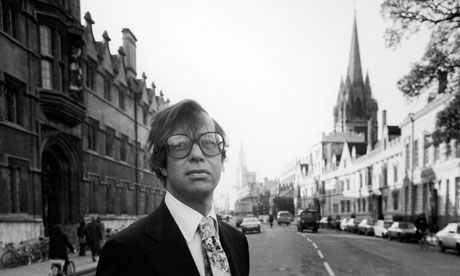
Ronald Dworkin at Oxford University in the 1970s. Photograph: Terrence Spencer/ Time & Life/Getty
Ronald Dworkin, who has died aged 81, was widely respected as the most original and powerful philosopher of law
in the English-speaking world. In his books, his articles and his
teaching, in London and New York, he developed a powerful, scholarly
exegesis of the law, and expounded issues of burning topicality and
public concern – including how the law should deal with race, abortion,
euthanasia and equality – in ways that were accessible to lay readers.
His legal arguments were subtly presented applications to specific
problems of a classic liberal philosophy
which, in turn, was grounded in his belief that law must take its
authority from what ordinary people would recognise as moral virtue.
Dworkin studied philosophy (under Willard Van Orman Quine at Harvard University and, informally, with JL Austin at Oxford University) and law at both Oxford and the Harvard Law School. He worked as clerk to the great US judge and legal scholar Billings Learned Hand and as a practising associate in the Wall Street law firm Sullivan & Cromwell, before teaching law at the Yale and later the New York University law schools, as well as at Oxford and later University College London.
This broad education and training, sharpening the analytical skills of a quite exceptionally powerful intellect, enabled him, even as a precocious young man, to challenge the most eminent figures in the world of law and jurisprudence, including Hand and HLA Hart, the renowned exponent of legal positivism – considering the social basis of a law separately from its merits – at Oxford. Perhaps Dworkin's greatest achievement was his insistence on a rights-based theory of law, expounded in his first and most influential book, Taking Rights Seriously (1977), in which he proposed an alternative both to Hart's outlook and to the newly minted theories of the Harvard philosopher of law John Rawls.
Dworkin spent much of his life in legal and philosophical controversy, in which he proved himself a capable and sometimes acerbic champion, defending his ideas with a sharpness that could surprise those who knew him personally as a gentle and affectionate man. He remained an unapologetic, indeed proud, liberal Democrat, unshaken in his loyalty to the New Deal tradition set by his hero Franklin D Roosevelt, even as such ideas became less and less widely held. It is possible that this shifting of the political centre of gravity under him deprived him of a more prominent career as a public intellectual. Within his own field, where law and philosophy meet, his reputation was unsurpassed, and almost unrivalled.
He was challenged technically within that field by the exponents of other doctrines, for example by the partisans of Hart, of Rawls and of Richard Rorty. He was more bitterly derided on political and ideological grounds by conservative legal scholars such as Robert Bork, with whom – improbably – he taught a joint course at the Yale Law School in the 60s. Throughout all these intellectual jousts, Dworkin was ever ready to break a lance, and gave at least as good as he got.
He chose to divide his life almost equally between Britain and the US, with a townhouse in London and an unusual 19th-century mews cottage just off Washington Square in New York, as well as a third home, on the island of Martha's Vineyard, Massachusetts, where he enjoyed sailing.
For a man who contrived, through sheer intellectual brilliance and a formidable capacity for work, to be both a consummate scholar's scholar and a lawyer's lawyer, Dworkin could give the impression of something not far from indolence. He loved company, talk, good food and drink, music, including opera, and travel, and moved easily through the different societies of New York and Martha's Vineyard, Oxford and London. Friends and family were more important to him than society, however, and work perhaps ultimately, in spite of his apparently self-indulgent lifestyle, more important than either.
Dworkin was born in Worcester, Massachusetts. His parents, David and Madeline (nee Talamo) separated when he was a baby, and his mother, a promising concert pianist, worked as a music teacher in Providence, Rhode Island, to support Ronald and his brother and sister. He went to a public school in Providence with a classical tradition, and won a scholarship to Harvard, where he achieved straight As in all his four years' classes.
Dworkin arrived as a Rhodes scholar at Magdalen College, Oxford, with a formidable reputation. Dons all but bowed before his record. He chose to read law, but he hung out with philosophers. (He also played a lot of bridge, much of it with his lifelong friend Guido Calabresi, later dean of the Yale Law School and an appeal court judge in Connecticut, New York and Vermont.) His Oxford finals papers were as impeccable as the Harvard ones: straight alphas, after straight As. His two years at Oxford finished, he went back to Harvard, this time to read law. The law school gave him credit for his Oxford degree, so there were areas of the law (including criminal law) he never studied.
The conventional start to a brilliant legal career in the US is to work as a clerk to a leading judge. In 1957 Dworkin, on the basis of his exceptional record at Harvard, was chosen to clerk for Judge Learned Hand, then in his late 80s and the most eminent judge in the land outside the supreme court. Often Hand's clerks went on to work for Justice Felix Frankfurter, and were made for life.
Hand explained that he did not need Dworkin to draft opinions for him: "I don't know how you write," the great man said. "I write very well." He asked him instead to read what he had written. This led immediately to a difference of opinion. Hand was writing a series of Oliver Wendell Holmes lectures for Harvard in which he questioned whether the Brown case (Brown v School Board, in which the supreme court, in 1954, held for the first time that racially segregated education was necessarily unconstitutional) had been wrongly decided. Dworkin bravely challenged Hand to say publicly that Brown was wrong.
While he was working for Hand, Dworkin met his future wife Betsy Ross, the daughter of a successful businessman from the New York garment district who lived on Fifth Avenue. On one of their first dates, Dworkin told her that he had to drop off a document at the judge's house and asked her to come with him, saying it would take only a second. Learned Hand opened the door and pressed the young people to come in. He mixed dry martinis and talked to them for two hours. As they left walking down the steps from the front door, Betsy asked: "If I see more of you, do I get to see more of him?" They were married in 1958.
Dworkin was duly offered the chance of clerking for Frankfurter, who was famous not only for his astute legal scholarship but also for the skill with which he promoted his proteges' careers. Instead, he took up an offer to work for Sullivan & Cromwell. One of his clients was the Swedish Wallenberg family and he had to spend a lot of time in Stockholm.
It was not long before Betsy objected to the amount of time her new husband spent travelling. She sent him a telegram saying that in a year he would have to get a new job or a new wife. Dworkin left the law firm and got a job teaching at Oxford. For a time the couple lived in the Oxfordshire countryside, but that was not the natural habitat for an elegant New Yorker like Betsy. Instead, they bought a house in Belgravia and Dworkin travelled to Oxford from the nearby Victoria coach station, leaving the bus outside University College, where he had his teaching rooms.
In 1961, Betsy had twins, Anthony, who now works on human rights and democracy at the European Council on Foreign Relations thinktank, and Jennifer, an award-winning documentary film producer. In the same year, Dworkin was made a professor at the Yale Law School, and also master of one of the Yale residential colleges, Trumbull. It fell to him in the late 60s to have to deal with the student unrest. Dworkin left Yale and became a professor at the New York University Law School. Arthur Schlesinger persuaded him that he would be happier in New York than at either Harvard or Yale. "New York is for grownups," the historian said gnomically.
Hart, who had been one of Dworkin's examiners at Oxford, was by then approaching retirement, and in 1969 he was able to persuade the Oxford law faculty to appoint Dworkin as his successor as professor of jurisprudence. As with Hand, Dworkin had learned from an older man, then crossed swords with him intellectually, but remained on good terms with him. He stayed in the post until 1998. Eventually, he accepted a chair in jurisprudence at University College London, perhaps on the principle that London, too, was for grownups.
His books were immensely influential, especially in US law schools. He published many articles both in technical law journals and also in the New York Review of Books, none more important than his critique in several articles in 1977 and 1978 of the supreme court's inconclusive decision of the Regents of the University of California v Bakke case, which arose out of widespread dissatisfaction with "affirmative action", or positive discrimination. Dworkin had by then already completed Taking Rights Seriously, in which he attacked legal positivism of the kind espoused by Hart, and elevated rights above formal law, at least in some hard cases. "If the issue is one touching fundamental personal or political rights," he wrote, "and it is arguable that the supreme court has made a mistake, a man is within his social rights in refusing to accept that decision as conclusive."
If one can dare to summarise so rich and lucid a lifetime's argument, Dworkin rejected both the traditional view, that judges must conform to established authority, and the belief of American liberals, that judges should seek to improve society, with a new emphasis on the judge's responsibility to uphold individual and collective morality.
After that came A Matter of Principle (1985), about the sources of law, and Law's Empire (1986), a full-dress theory of law. In Life's Dominion (1993) he tried characteristically to find common ground on abortion between pro-life and pro-choice forces in a common respect for human life. "Combatants and commentators alike talk as if the abortion controversy was about the rights and interests of a foetus ... liberals and conservatives, Catholics and feminists, actually argue about how and why human life has intrinsic value. This contradicts the pessimistic conclusion that accommodation is impossible." In Sovereign Virtue (2000), he wrestled with alternative views of equality, and in Justice in Robes (2006), he returned to a lifelong fascination with judges and the nature of adjudication.
Dworkin was always aware that law and in particular adjudication were, as he once put it, "a branch of morality". In 2011 he published Justice for Hedgehogs, an extended essay on this insight. The title was a reference to Isaiah Berlin's famous distinction between those intellectuals who, like the fox, have many ideas, and those who have "one big idea". Dworkin's big idea was to put human dignity at the centre of his moral system, for judges and for others. "If we manage to lead a good life," he wrote, "we make our lives tiny diamonds in the cosmic sands."
In 2000, Betsy died of cancer. Dworkin formed a close friendship with Irene Brendel, wife of the pianist Alfred Brendel, and they later married. He is survived by Irene, Anthony and Jennifer, and two grandchildren.
Ronald Myles Dworkin, philosopher of law, born 11 December 1931; died 14 February 2013
Dworkin studied philosophy (under Willard Van Orman Quine at Harvard University and, informally, with JL Austin at Oxford University) and law at both Oxford and the Harvard Law School. He worked as clerk to the great US judge and legal scholar Billings Learned Hand and as a practising associate in the Wall Street law firm Sullivan & Cromwell, before teaching law at the Yale and later the New York University law schools, as well as at Oxford and later University College London.
This broad education and training, sharpening the analytical skills of a quite exceptionally powerful intellect, enabled him, even as a precocious young man, to challenge the most eminent figures in the world of law and jurisprudence, including Hand and HLA Hart, the renowned exponent of legal positivism – considering the social basis of a law separately from its merits – at Oxford. Perhaps Dworkin's greatest achievement was his insistence on a rights-based theory of law, expounded in his first and most influential book, Taking Rights Seriously (1977), in which he proposed an alternative both to Hart's outlook and to the newly minted theories of the Harvard philosopher of law John Rawls.
Dworkin spent much of his life in legal and philosophical controversy, in which he proved himself a capable and sometimes acerbic champion, defending his ideas with a sharpness that could surprise those who knew him personally as a gentle and affectionate man. He remained an unapologetic, indeed proud, liberal Democrat, unshaken in his loyalty to the New Deal tradition set by his hero Franklin D Roosevelt, even as such ideas became less and less widely held. It is possible that this shifting of the political centre of gravity under him deprived him of a more prominent career as a public intellectual. Within his own field, where law and philosophy meet, his reputation was unsurpassed, and almost unrivalled.
He was challenged technically within that field by the exponents of other doctrines, for example by the partisans of Hart, of Rawls and of Richard Rorty. He was more bitterly derided on political and ideological grounds by conservative legal scholars such as Robert Bork, with whom – improbably – he taught a joint course at the Yale Law School in the 60s. Throughout all these intellectual jousts, Dworkin was ever ready to break a lance, and gave at least as good as he got.
He chose to divide his life almost equally between Britain and the US, with a townhouse in London and an unusual 19th-century mews cottage just off Washington Square in New York, as well as a third home, on the island of Martha's Vineyard, Massachusetts, where he enjoyed sailing.
For a man who contrived, through sheer intellectual brilliance and a formidable capacity for work, to be both a consummate scholar's scholar and a lawyer's lawyer, Dworkin could give the impression of something not far from indolence. He loved company, talk, good food and drink, music, including opera, and travel, and moved easily through the different societies of New York and Martha's Vineyard, Oxford and London. Friends and family were more important to him than society, however, and work perhaps ultimately, in spite of his apparently self-indulgent lifestyle, more important than either.
Dworkin was born in Worcester, Massachusetts. His parents, David and Madeline (nee Talamo) separated when he was a baby, and his mother, a promising concert pianist, worked as a music teacher in Providence, Rhode Island, to support Ronald and his brother and sister. He went to a public school in Providence with a classical tradition, and won a scholarship to Harvard, where he achieved straight As in all his four years' classes.
Dworkin arrived as a Rhodes scholar at Magdalen College, Oxford, with a formidable reputation. Dons all but bowed before his record. He chose to read law, but he hung out with philosophers. (He also played a lot of bridge, much of it with his lifelong friend Guido Calabresi, later dean of the Yale Law School and an appeal court judge in Connecticut, New York and Vermont.) His Oxford finals papers were as impeccable as the Harvard ones: straight alphas, after straight As. His two years at Oxford finished, he went back to Harvard, this time to read law. The law school gave him credit for his Oxford degree, so there were areas of the law (including criminal law) he never studied.
The conventional start to a brilliant legal career in the US is to work as a clerk to a leading judge. In 1957 Dworkin, on the basis of his exceptional record at Harvard, was chosen to clerk for Judge Learned Hand, then in his late 80s and the most eminent judge in the land outside the supreme court. Often Hand's clerks went on to work for Justice Felix Frankfurter, and were made for life.
Hand explained that he did not need Dworkin to draft opinions for him: "I don't know how you write," the great man said. "I write very well." He asked him instead to read what he had written. This led immediately to a difference of opinion. Hand was writing a series of Oliver Wendell Holmes lectures for Harvard in which he questioned whether the Brown case (Brown v School Board, in which the supreme court, in 1954, held for the first time that racially segregated education was necessarily unconstitutional) had been wrongly decided. Dworkin bravely challenged Hand to say publicly that Brown was wrong.
While he was working for Hand, Dworkin met his future wife Betsy Ross, the daughter of a successful businessman from the New York garment district who lived on Fifth Avenue. On one of their first dates, Dworkin told her that he had to drop off a document at the judge's house and asked her to come with him, saying it would take only a second. Learned Hand opened the door and pressed the young people to come in. He mixed dry martinis and talked to them for two hours. As they left walking down the steps from the front door, Betsy asked: "If I see more of you, do I get to see more of him?" They were married in 1958.
Dworkin was duly offered the chance of clerking for Frankfurter, who was famous not only for his astute legal scholarship but also for the skill with which he promoted his proteges' careers. Instead, he took up an offer to work for Sullivan & Cromwell. One of his clients was the Swedish Wallenberg family and he had to spend a lot of time in Stockholm.
It was not long before Betsy objected to the amount of time her new husband spent travelling. She sent him a telegram saying that in a year he would have to get a new job or a new wife. Dworkin left the law firm and got a job teaching at Oxford. For a time the couple lived in the Oxfordshire countryside, but that was not the natural habitat for an elegant New Yorker like Betsy. Instead, they bought a house in Belgravia and Dworkin travelled to Oxford from the nearby Victoria coach station, leaving the bus outside University College, where he had his teaching rooms.
In 1961, Betsy had twins, Anthony, who now works on human rights and democracy at the European Council on Foreign Relations thinktank, and Jennifer, an award-winning documentary film producer. In the same year, Dworkin was made a professor at the Yale Law School, and also master of one of the Yale residential colleges, Trumbull. It fell to him in the late 60s to have to deal with the student unrest. Dworkin left Yale and became a professor at the New York University Law School. Arthur Schlesinger persuaded him that he would be happier in New York than at either Harvard or Yale. "New York is for grownups," the historian said gnomically.
Hart, who had been one of Dworkin's examiners at Oxford, was by then approaching retirement, and in 1969 he was able to persuade the Oxford law faculty to appoint Dworkin as his successor as professor of jurisprudence. As with Hand, Dworkin had learned from an older man, then crossed swords with him intellectually, but remained on good terms with him. He stayed in the post until 1998. Eventually, he accepted a chair in jurisprudence at University College London, perhaps on the principle that London, too, was for grownups.
His books were immensely influential, especially in US law schools. He published many articles both in technical law journals and also in the New York Review of Books, none more important than his critique in several articles in 1977 and 1978 of the supreme court's inconclusive decision of the Regents of the University of California v Bakke case, which arose out of widespread dissatisfaction with "affirmative action", or positive discrimination. Dworkin had by then already completed Taking Rights Seriously, in which he attacked legal positivism of the kind espoused by Hart, and elevated rights above formal law, at least in some hard cases. "If the issue is one touching fundamental personal or political rights," he wrote, "and it is arguable that the supreme court has made a mistake, a man is within his social rights in refusing to accept that decision as conclusive."
If one can dare to summarise so rich and lucid a lifetime's argument, Dworkin rejected both the traditional view, that judges must conform to established authority, and the belief of American liberals, that judges should seek to improve society, with a new emphasis on the judge's responsibility to uphold individual and collective morality.
After that came A Matter of Principle (1985), about the sources of law, and Law's Empire (1986), a full-dress theory of law. In Life's Dominion (1993) he tried characteristically to find common ground on abortion between pro-life and pro-choice forces in a common respect for human life. "Combatants and commentators alike talk as if the abortion controversy was about the rights and interests of a foetus ... liberals and conservatives, Catholics and feminists, actually argue about how and why human life has intrinsic value. This contradicts the pessimistic conclusion that accommodation is impossible." In Sovereign Virtue (2000), he wrestled with alternative views of equality, and in Justice in Robes (2006), he returned to a lifelong fascination with judges and the nature of adjudication.
Dworkin was always aware that law and in particular adjudication were, as he once put it, "a branch of morality". In 2011 he published Justice for Hedgehogs, an extended essay on this insight. The title was a reference to Isaiah Berlin's famous distinction between those intellectuals who, like the fox, have many ideas, and those who have "one big idea". Dworkin's big idea was to put human dignity at the centre of his moral system, for judges and for others. "If we manage to lead a good life," he wrote, "we make our lives tiny diamonds in the cosmic sands."
In 2000, Betsy died of cancer. Dworkin formed a close friendship with Irene Brendel, wife of the pianist Alfred Brendel, and they later married. He is survived by Irene, Anthony and Jennifer, and two grandchildren.
Ronald Myles Dworkin, philosopher of law, born 11 December 1931; died 14 February 2013
08 februari, 2013
The Nordic countries...
SMALLISH countries are often in the vanguard when it comes to reforming government. In the 1980s Britain was out in the lead, thanks to Thatcherism and privatisation. Tiny Singapore has long been a role model for many reformers. Now the Nordic countries are likely to assume a similar role.
That is partly because the four main Nordics—Sweden, Denmark, Norway and Finland—are doing rather well. If you had to be reborn anywhere in the world as a person with average talents and income, you would want to be a Viking. The Nordics cluster at the top of league tables of everything from economic competitiveness to social health to happiness. They have avoided both southern Europe’s economic sclerosis and America’s extreme inequality. Development theorists have taken to calling successful modernisation “getting to Denmark”. Meanwhile a region that was once synonymous with do-it-yourself furniture and Abba has even become a cultural haven, home to “The Killing”, Noma and “Angry Birds”.
As our special report this week explains, some of this is down to lucky timing: the Nordics cleverly managed to have their debt crisis in the 1990s. But the second reason why the Nordic model is in vogue is more interesting. To politicians around the world—especially in the debt-ridden West—they offer a blueprint of how to reform the public sector, making the state far more efficient and responsive.
From Pippi Longstocking to private schools
The idea of lean Nordic government will come as a shock both to
French leftists who dream of socialist Scandinavia and to American
conservatives who fear that Barack Obama is bent on “Swedenisation”.
They are out of date. In the 1970s and 1980s the Nordics were indeed
tax-and-spend countries. Sweden’s public spending reached 67% of GDP in
1993. Astrid Lindgren, the inventor of Pippi Longstocking, was forced to
pay more than 100% of her income in taxes. But tax-and-spend did not
work: Sweden fell from being the fourth-richest country in the world in
1970 to the 14th in 1993.Since then the Nordics have changed course—mainly to the right. Government’s share of GDP in Sweden, which has dropped by around 18 percentage points, is lower than France’s and could soon be lower than Britain’s. Taxes have been cut: the corporate rate is 22%, far lower than America’s. The Nordics have focused on balancing the books. While Mr Obama and Congress dither over entitlement reform, Sweden has reformed its pension system (see Free exchange). Its budget deficit is 0.3% of GDP; America’s is 7%.
On public services the Nordics have been similarly pragmatic. So long as public services work, they do not mind who provides them. Denmark and Norway allow private firms to run public hospitals. Sweden has a universal system of school vouchers, with private for-profit schools competing with public schools. Denmark also has vouchers—but ones that you can top up. When it comes to choice, Milton Friedman would be more at home in Stockholm than in Washington, DC.
All Western politicians claim to promote transparency and technology. The Nordics can do so with more justification than most. The performance of all schools and hospitals is measured. Governments are forced to operate in the harsh light of day: Sweden gives everyone access to official records. Politicians are vilified if they get off their bicycles and into official limousines. The home of Skype and Spotify is also a leader in e-government: you can pay your taxes with an SMS message.
This may sound like enhanced Thatcherism, but the Nordics also offer something for the progressive left by proving that it is possible to combine competitive capitalism with a large state: they employ 30% of their workforce in the public sector, compared with an OECD average of 15%. They are stout free-traders who resist the temptation to intervene even to protect iconic companies: Sweden let Saab go bankrupt and Volvo is now owned by China’s Geely. But they also focus on the long term—most obviously through Norway’s $600 billion sovereign-wealth fund—and they look for ways to temper capitalism’s harsher effects. Denmark, for instance, has a system of “flexicurity” that makes it easier for employers to sack people but provides support and training for the unemployed, and Finland organises venture-capital networks.
The sour part of the smorgasbord
The new Nordic model is not perfect. Public spending as a proportion
of GDP in these countries is still higher than this newspaper would
like, or indeed than will be sustainable. Their levels of taxation still
encourage entrepreneurs to move abroad: London is full of clever young
Swedes. Too many people—especially immigrants—live off benefits. The
pressures that have forced their governments to cut spending, such as
growing global competition, will force more change. The Nordics are
bloated compared with Singapore, and they have not focused enough on
means-testing benefits.All the same, ever more countries should look to the Nordics. Western countries will hit the limits of big government, as Sweden did. When Angela Merkel worries that the European Union has 7% of the world’s population but half of its social spending, the Nordics are part of the answer. They also show that EU countries can be genuine economic successes. And as the Asians introduce welfare states they too will look to the Nordics: Norway is a particular focus of the Chinese.
The main lesson to learn from the Nordics is not ideological but practical. The state is popular not because it is big but because it works. A Swede pays tax more willingly than a Californian because he gets decent schools and free health care. The Nordics have pushed far-reaching reforms past unions and business lobbies. The proof is there. You can inject market mechanisms into the welfare state to sharpen its performance. You can put entitlement programmes on sound foundations to avoid beggaring future generations. But you need to be willing to root out corruption and vested interests. And you must be ready to abandon tired orthodoxies of the left and right and forage for good ideas across the political spectrum. The world will be studying the Nordic model for years to come.
05 februari, 2013
Prenumerera på:
Inlägg (Atom)